




Friends,
Throughout the course of America’s history, economic, political and social conditions have seldom favored the communities served by HOPE. Inadequate investment in education, healthcare, businesses, housing, water systems, technology, and other vital infrastructure necessary for people to realize their potential, has long plagued rural towns across the Mississippi Delta and Alabama Black Belt, and in low-income neighborhoods throughout Jackson, New Orleans, Memphis, Little Rock, Montgomery, and Birmingham.
Similarly tenacious is HOPE’s dedication to closing these gaps. Over the past three decades, we have witnessed the resilience of Deep South residents, and how their potential blossoms when they have access to resources and opportunities on a level comparable to others who enjoy greater levels of affluence and privilege.
Going forward, as in the past, HOPE will stand in the breach, equipping people to buy their first home, to grow their family-owned business, and purchase a vehicle buttressed by the knowledge that the benefits of the financial system, a clean environment – life, liberty. and the pursuit of happiness – are available to them too.
People like Ivory Lee, a maternity nurse, who upon learning that she would become a mother, needed a place to raise her first born child. And Terry Jackson, Sr., a mason teaching his sons the trade, in need of a line of credit to take on larger projects. And Jeffery Crosby, who bought his new electric vehicle through HOPE.
Please continue to join us in this important work. Whether it’s through a Transformational Deposit, a tax-exempt donation, or as a partner, your support makes it possible for HOPE to create opportunity where it’s needed most. Thank you for being an ally in our ongoing efforts to improve lives in the Deep South.
In unity,

Chief Executive Officer

Special Deliveries
Ivory Lee is a registered nurse who spends time with new mothers and babies in the maternity ward. When she learned that she was going to be a mother herself, her first thought was to have a place for her family. Although she always wanted to become a homeowner, she never thought it would be possible or this soon. With a baby on the way, she knew that the time was now to strive toward homeownership. “I wanted to have a place for when my child was born… a place they could call home,” says Lee. She began working with her realtor in her hometown of Mobile, Alabama to look for houses. “I went to my bank for a loan and did not like the options they had available,” said Lee. Lee’s realtor put her in contact with a mortgage loan officer at Hope Credit Union. “I called HOPE, and the loan officer went to work immediately… I just remember thinking, is this really happening?” said Lee.
HOPE approved Lee for a 30-year fixed rate loan through the Affordable Home Program. Lee was overjoyed to close on her first home in October 2024. “It’s a great feeling to be able to decorate the house and have family over for the holidays,” Lee said. She enjoys her new neighbors and community.
Building a Solid Future
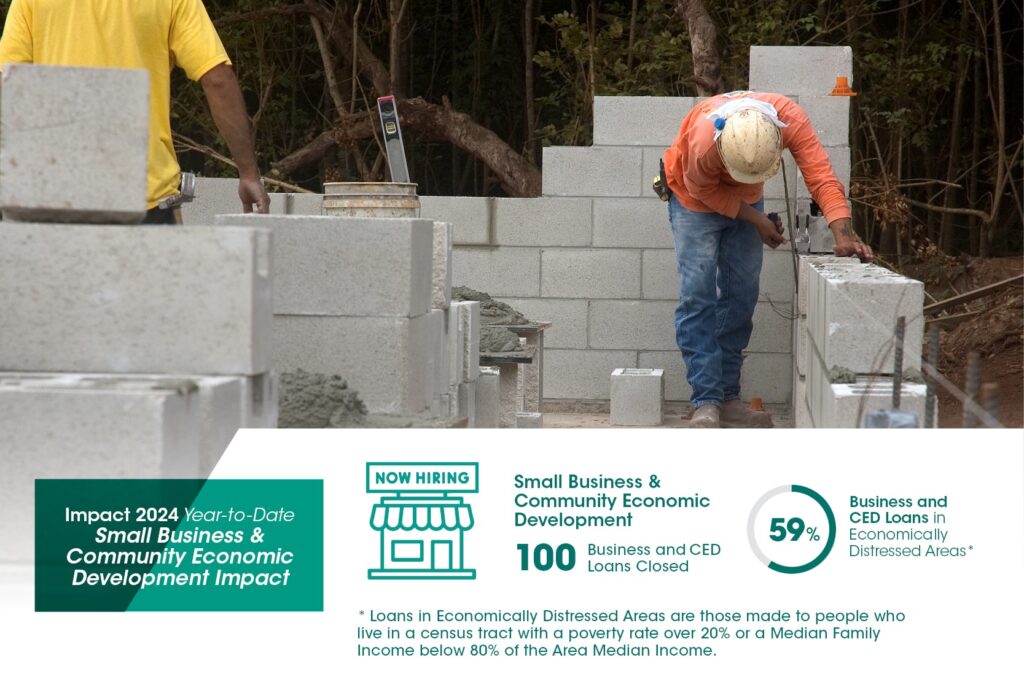
Terry Jackson, Sr., a masonry contractor and owner of Terry for Bricks, has been in business since the late 1980s. Working with his two sons, Terry Jr. and Jermaine in Montgomery, Alabama, the business thrived focusing on residential construction. In recent years, Jackson saw an increased demand for nonresidential construction. To compete for the larger commercial jobs, Jackson required additional equipment and working capital. He approached Hope Credit Union to open a line of credit. “The loan officer at HOPE delivered on everything he said he would do, and I am happy,” said Jackson. He received a $15,000 small business loan from HOPE. Jackson now takes on masonry jobs across the entire state of Alabama. “I’m very pleased with the service I received at HOPE,” said Jackson.

Empowering Women, Rebuilding Lives
Musee is a local manufacturer specializing in premium bath products. All products are handmade in Mississippi by women in recovery from substance abuse and incarceration. “We really believe you don’t define a person by their past, but you look at their potential and the possibilities,” said CEO and co-founder Leisha Pickering. Musee offers a safe place to work while the women rebuild their lives, striving in its overall mission of empowering women to rewrite their stories and create brighter futures. Pickering started her company in her kitchen, making bath bombs. Ten years later, Musee Bath sells 15 different homemade products. As the company grew, demand increased for large orders. Pickering reached out to HOPE to support the growth of the business. HOPE responded with a $338,000 line of credit. The line of credit positioned Musee to meet larger orders on time by covering the costs for manufacturing, packaging, and the day-to-day operational needs managed by Musee’s 50 employees. “People I meet will tell me that I am so passionate about our products…but what I am really passionate about is the hands that make our products,” said Pickering.

Smooth Ride to Electric
Jeffery Crosby hadn’t purchased a vehicle in years, and the entire process of purchasing an electric vehicle was foreign. He knew he wanted a vehicle he could charge at home – saving on gas – and, ideally, something that fit his budget. When he found Hope Credit Union’s electric vehicle (EV) loan program, he decided to take a chance and applied online. He was called the next day by a HOPE representative who reassured him that they would help him through every step of the process. Mr. Crosby was quickly preapproved and started shopping. He asked a range of questions from vehicle selection to the installation of a home charger. HOPE’s team walked him through it all, informing him of the home charger installation costs covered by HOPE’s EV program. Appreciating the convenience of handling everything electronically, he completed all documents remotely before visiting the Madison Avenue branch to pick up the payment for the dealer. Soon after, he drove off the lot in his first electric vehicle. Reflecting on the experience, he expressed how easy it was to apply for the loan, and he was grateful to have HOPE as part of this new journey.

Making a Winning Play
Kristian Fulton, cornerback for the Los Angeles Chargers, makes the right plays on the field and in his community. After transitioning from college football to the NFL, Fulton’s parents, Keith Sr. and Michelle Fulton, encouraged him to invest in property in the city of New Orleans. The Fultons found property built in the 1940s in Tremé, one of the oldest neighborhoods in New Orleans. “We were very interested in this area…Tremé is historic and known for jazz, soul food, and its African-American and Creole heritage,” says Keith Fulton, Sr. A family friend put the Fultons in contact with a loan officer at Hope Credit Union. “I like that I can go to a HOPE branch and the people look like me and understand my needs,” he added. With his parents leading the effort on his behalf, Kristian purchased his first property, an eight-unit building with financing from HOPE. “HOPE made it so easy when it came to sending documents to Kristian to sign while he was away,” said Michelle Fulton. The Fulton family maintains the multi-unit building and is looking to invest in more properties around Tremé where tenants can enjoy the peace and quiet of the community.

Seizing the Moment: Maximizing Federal Investments in Under-Resourced Communities
HOPE Economic Mobility Forum, held in West Memphis, Arkansas, was the third and last of the 2024 convenings of community leaders, policymakers, and experts who gathered to discuss the effective utilization of federal investments in the Deep South to enhance economic mobility. The Hope Policy Institute set the stage by addressing the economic mobility challenges and opportunities in the Deep South. The Forum also featured a panel on Community Perspectives, which included representatives from the Arkansas Black Mayor’s Association and Communities Unlimited. Representatives from federal agencies such as the U.S. Small Business Administration, USDA Rural Development, U.S. Department of the Treasury, U.S. Environmental Protection Agency, and the Federal Highway Administration shared valuable insights into the local factors influencing economic mobility and the utilization of resources to address community needs.

HOPE Economic Empowerment Center Groundbreaking Ceremony
On October 30, 2024, HOPE held a groundbreaking ceremony for the HOPE Economic Empowerment Center in Jackson, Mississippi. The new center, will provide members with a comprehensive suite of products and services to meet their individual financial needs and the needs of their families and businesses. HOPE will also use the space to partner with area nonprofits and other organizations to provide financial counseling and to host meetings to discuss issues and solutions related to economic mobility in their community. The renovation of the formerly vacant building will model design elements such as solar power and efficiency upgrades that lower energy costs and serve as an anchor for reinvestment in a neighborhood affected by commercial outmigration.
Learn more about this new resource for the Jackson metro area at www.hopecu.org/heec24.

Hope Policy Institute Featured on PBS Show “Origins”
The Hope Policy Institute was recently featured on the PBS show “Origins” to discuss the impact of Black-owned financial institutions and their pivotal role in closing the racial wealth gap. The interview follows Black Americans’ financial struggles, including lending and housing discrimination, from segregation to today, and how the earliest Black financial institutions, like Alabama Penny Savings Bank, took charge of rebuilding Black communities. In an interview for the show, Hope Policy Institute director, Kiyadh Burt opined “Black communities found ways to create mutual aid opportunities, credit unions, and cooperative efforts to make sure that, as they were locked out from mainstream financial institutions, they had the systems in place to make sure that their financial needs were met.” Watch the full PBS interview with host Harini Bhat for more insight.